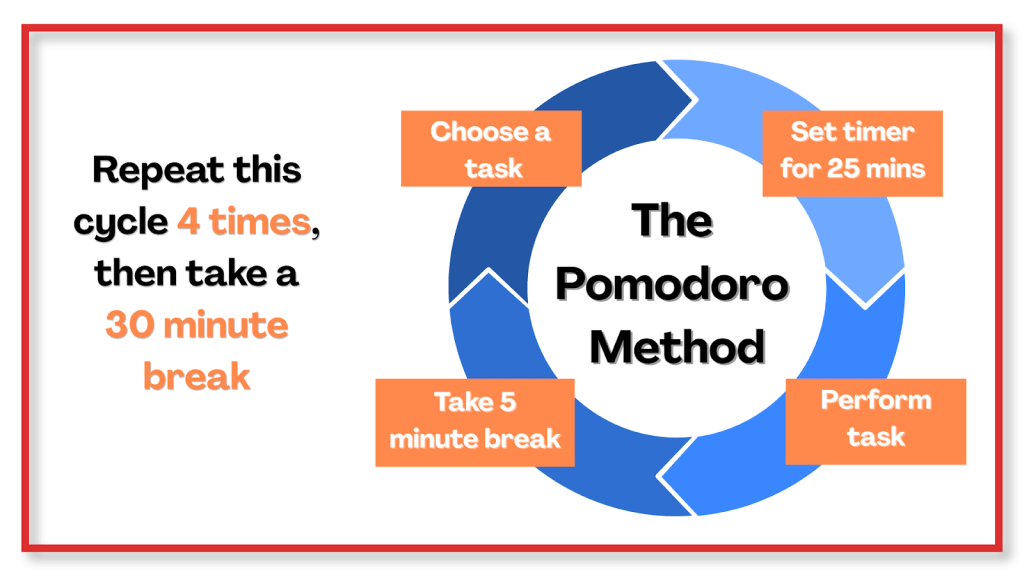
The Pomodoro Method is a time management technique. Let’s say that you have a task to create a slideshow, clean your kitchen, build a cabinet, or cook a recipe, but you don’t really feel like starting it. You would tell yourself that you’ll do some Pomodoros and that when the Pomodoros are done, you can do whatever you want. Pomodoro are intervals of 25 minutes of work, divided by 5-minute breaks. After 4 sets of Pomodoros, you would take a 30 minute break to do whatever you like. Once you get used to the Pomodoro method, you can create interval lengths of your own choosing, but when you’re just getting started, it’s best to stick to the traditional method.
When do you stop? You can decide how many rounds you want to do in advance. You may decide to do only one round to start, or even just one interval to start. The point is to pick something that you can commit to.
Using the Pomodoro Method can also help you manage your anxieties. If you have a task you need to focus on, but there’s something on your mind, you can tell yourself that you can stress about that thing that’s bothering you during your break or during your second interval. You’ll often find that once you start an interval, you get into a state of flow or that the task isn’t as hard as you thought it would be.
How the Pomodoro Method Helps with Anxiety
Anxiety often arises because you feel overwhelmed by a task and you don’t know where to start. Some experts describe anxiety as a dysfunctional relationship with uncertainty. The Pomodoro Method helps you provide structure, even for that uncertainty. For instance, you might decide that you want to start applying for jobs, but you’re uncertain where to start, or you’re overwhelmed by your spotty employment record, or you’re worried about references. You could tell yourself that you will spend the first interval writing down everything you’re stressed out about: 1) no references, 2) limited experience, 3) wondering what’s the point, 4) unable to pass a background check.
Here’s the thing: you’ll find that listing the things that are stressing you out takes less time than you think. Then, you can dedicate each Pomodoro to completing tasks linked to positive what ifs. What if I sent one email to someone asking them to be my reference? The worst they can say is no. I’m going to spend one Pomodoro writing a text or an email making a polite, respectful request. Then, I can do whatever I want whether that’s scrolling or worrying or whatever other coping mechanism I use.
But here’s the thing. You may find that after writing and sending that request off, you want to be ready in case they say yes. So you tell yourself that after that five-minute break, you’ll spend the next Pomodoro interval refreshing your resume, just in case.
Quick warning: When you build momentum, your ego is going to want to daydream about what life is going to be like once you’re successful. You’re going to want to message people to “warn” them that this is their last chance to support you or that you’re in the process of culling people out of your life. You may want to start posting this on social media. I would encourage you to resist the temptation. Instead, use that energy to either give thanks based on your own spiritual or religious tradition or mental health tradition and to take care of yourself by getting some water, getting something to eat (try to avoid just spending money on takeout cause you’re going to want to feel like rewarding yourself), or taking care of yourself physically by either taking a shower or doing something as simple as clipping your nails.
How the Pomodoro Method Helps with Time Management
Time management is about planning how you’re going to use your time (and energy) and also being aware of how much time something is taking up. Conversations about time management often focus on the first half, when in reality, they are also the second half is just as important. If you actually take the time to complete a task, you know the effort it takes to complete it. That will allow you to properly assess its value in your life and make beneficial trades with people. You’ll know what’s actually worth your time and what’s worth trading money for. It’ll help you not feel like someone is taking advantage of you, and it’ll help you engage in peer-to-peer relationships with others. It also helps you become more humble and help you realize that there are some things you do really well within time and resource constraints, and some things that others do really well within time and resource constraints.
How the Pomodoro Method Helps with Consistency
Sometimes, you do not know what it takes to get a certain result. You just know that you want a result. In that case, your task is showing up consistently. Pomodoros can help you become consistent. If you don’t know how to break into a certain industry, you may tell yourself that you’re going to spend one interval reading about the industry and one interval taking a specific action related to what you just read. The next day you do the same until you start to become familiar with the path. It may take time and it may feel like an overwhelming, hopeless task. The Pomodoros help you take baby steps within your current life and abilities. Plus, you can track your progress. This data will help you when you want to take on another insurmountable task. You’ll realize that despite how hopeless it felt, when you look at the data, that hopelessness was only after 2 weeks of effort at 50 minutes a day. You’ll then gain a new map or gauge of how your mind and your emotions work for or against your goals.
How the Pomodoro Method Helps with Developing Responsibility
My writing: Responsibility is about your ability to respond. When you have a false identity – one that’s built on lies and ego and spin and perception – you do not have a clear understanding of your abilities. This makes it difficult for you to take responsibility. You can mimic taking responsibility by giving away a lot of energy – aka showboating, pulling all nighters, controlling the narrative, spending enormous amounts of money to cover for yourself – but this makes you wind up feeling burnt out, exhausted, unappreciated, resentful, and angry. As a result, you’re not responding – you’re reacting. You’re not responsible. You’re reactive.
On the other hand, when you have a clear understanding of your skills and abilities, you can respond. You do not feel the need to play God, which means trying to control for every possible outcome and every possible variable and reacting with rage when there’s a variable that is out of your control. Instead, you can respond with what you know, what you can do, and what you need to carry out your skills. You can do your best. That understanding allows you to also let other people do their best and to calmly assess them on their skills alone when they’re not doing their best.
 The Magnetized Man
Leave a comment