Nietzsche believed that creativity was a combination of “Dionysian” passion and “Apollonian” discipline. When we’re thinking about what it means to be creative, this idea of “disciplined passion” is a great jumping off point. It allows us to be in tune with the mystery of creativity, beauty, innovation, and art while also approaching our creative projects in a structured way.
Skills for Success defines creativity and innovation as “your ability to imagine, develop, express, encourage, and apply ideas in ways that are novel, unexpected, or challenge existing methods and norms.” If this sounds overwhelming, there are frameworks that can help you accomplish this.
Component 1: Use your imagination and curiosity
There are a few frameworks that you can use for imagining different situations and possibilities.
- Scenario Planning
- Dator’s Scenario Archetypes
- Futures Wheel
- Future Cone (Cone of Plausibility)
- Backcasting (Normative Scenarios)
What is Scenario Planning?
This is a method in which you imagine different “what if” scenarios. It’s often used by businesses and combines storytelling with quantitative analysis. To avoid this exercise getting out of hand, it’s important to think of 3 to 5 distinct scenarios, constrained by a single variable such as money, time, or resources.
What is Dator’s Scenario Archetypes?
Dator’s Scenario Archetypes, also known as Four Generic Futures, is a framework from Jim Dator that says that most narratives about the future can be put into one of four categories: Baseline, Collapse, New Equilibrium, and Transformation. You can use these archetypes to structure thinking about your own future and think of what you would do under each of these scenarios. The trick is not to obsessively spiral about each of these futures. Instead of being overly optimistic or overly pessimistic, decide that all four are equally possible and ask yourself what you would do with the opportunities or limitations of each scenario.
What is the Futures Wheel?
The Futures Wheel is a visualization tool and exercise developed by Jerome C. Glenn. It helps you identify what the first-order, second-order, and third-order impacts of a specific action will be. The trend, decision, or action is placed in the centre. You can see a modified example of this on Accenture’s website.
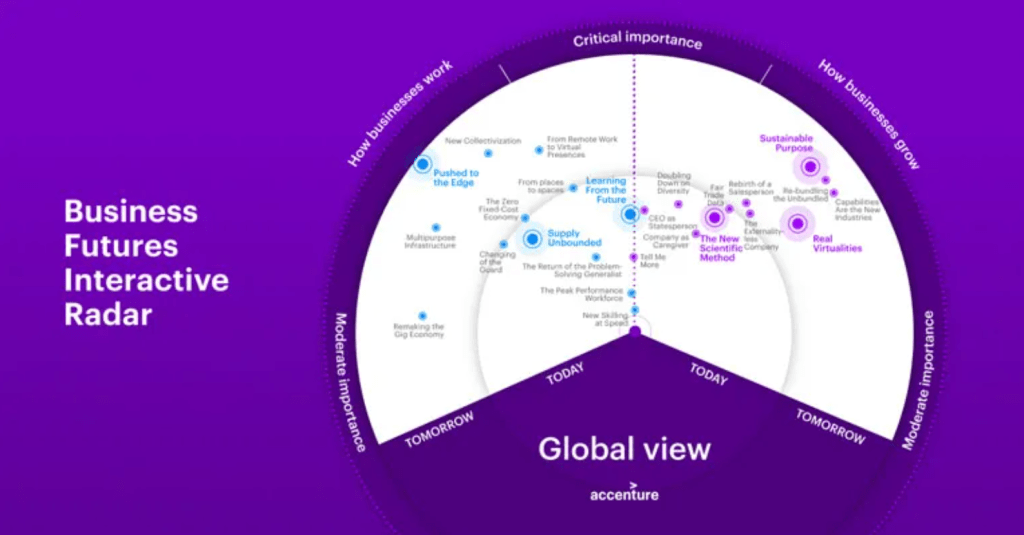
Source: Accenture Newsroom
What is the Future Cone (Cone of Plausibility) Framework?
This is a framework for helping people with future planning. Your present state is your apex or tip. This is what you currently know to be true based on data and evidence. As the cone widens, it encapsulates more and more possible outcomes. The types of futures that this future cone can help you speculate about ranges from straight line projections of current trends to preposterous or “crazy” futures.
What is Backcasting (Normative Scenarios)?
Let’s say you know what the goal is, but you know there is no logical progression towards that goal based on current trends. You think about a future that you want (this is a normative scenario) and then you think about the necessary actions or policies required to make that goal possible. This helps create systemic change.
There are also frameworks that you can use for divergent thinking, such as:
- SCAMPER
- Six Thinking Hats
What is the SCAMPER Framework?
The SCAMPER framework is a brainstorming technique that invites participants to answer seven different types of questions.
- Substitution Questions: What would happen if we replaced part of this idea, product, concept, or process with another part?
- Combination Questions: What would happen if we combined or merged two or more ideas, materials, or features?
- Adaption Questions: What would happen if we adapted this product or process to make it suitable for a different purpose, context, or need?
- Modification/Magnification/Minimization Question: What would happen if we changed the value of something by adjusting its form, its shape, its size, or its colour?
- “Put to another use” Question: What would happen if we introduced this to a new market?
- Elimination Question: What would happen if we removed certain elements of this process that we deem unnecessary?
- Reverse Question: What would happen if we re-ordered or reversed this process?
What is the Six Thinking Hats Framework?
The Six Thinking Hats Framework is a structured framework for decision-making and brainstorming. Each hat is a different colour and represents a different perspective:
- White Hat = Facts
- Red Hat = Feelings
- Black Hat = Caution
- Yellow Hat = Optimism
- Green Hat = Creativity
- Blue Hat = Control
This helps people wear the same hat at the same time and look in the same direction. You can use this to corral your own internal thoughts and feelings as well.
There are also frameworks that you can use for strategic and structural analysis, such as:
- Cynefin Framework
- SWOT Analysis
- STEEP/PESTEL Analysis
- Abstraction Laddering
What is the Cynefin Framework?
The Cynefin Framework helps people understand the nature of a problem and select the best approach. There are five domains of this framework:
- Clear: This is when you are in a stable environment with clear cause and effect. In this case, you would Sense, then Feel, then Respond.
- Complicated: There are several right answers, and you need expert analysis to determine cause and effect. In this case, you would Sense, then Analyze, then Respond.
- Complex: There are no immediately detectable cause-and-effect relationships, which means that you can only understand certain relationships in retrospect after experimentation. In this case, you would Probe, then Sense, then Respond.
- Chaotic: This is a situation where the situation is unstable and there are no clear or immediate cause-and-effect relationships, requiring immediate action to restore order and stability. In this case, you would Act, then Sense, then Respond.
- Disorder: This is the centre domain. This is when you have no idea which domain you are in.
What is a SWOT Analysis?
This is when you are assessing internal and external factors when deciding on a creative course of action. The components are:
- Strengths (Internal): These are positive, internal attributes that are within your control.
- Weaknesses (Internal): These are internal, negative attributes that are hard to control or change immediately.
- Opportunities (External): These are favourable attributes in your environment that you can be grateful for and use.
- Threats (External): These are unfavourable attributes in your environment that you cannot control or change immediately.
Component 2: Identify opportunities for you to innovate
There are frameworks that you can use to challenge norms, habits, and preconceptions in appropriate situations.
On the individual level, there are the following frameworks:
- The Habit Loop (Duhigg)
- Tiny Habits Framework (B.J. Fogg)
What is the Habit Loop by Duhigg?
The Habit Loop is a three-part neurological framework or pattern that focuses:
- Cue: This is what triggers the behaviour, either something internal (like a thought or feeling) or something external (like someone’s words).
- Routine: This is the behaviour – the actions that you routinely take. For instance,
- Reward: This is the positive reinforcement that tells your brain that this cycle is worth remembering and worth repeating.
The framework recommends keeping the cue but replacing the habit (the routine or the behaviour) with something more beneficial to you.
Component 3: Generate ideas that are novel to yourself or others
It can be hard to deviate from your existing processes, thinking, and approaches. This is where frameworks can help. Consider trying:
What is the OODA Loop?
The OODA Loop is a four-stage, iterative decision-making framework that you can use to adjust your thinking. It stands for the following:
- Observe: This is about collecting data and information about a situation or from the environment.
- Orient: This is about analyzing the information you’ve collected and finding connections.
- Decide: This is about selecting the best course of action based on the information that you have gathered.
- Act: This is about acting on your decision, which then leads you to generate new information and data, starting the next loop.
Component 4: Develop your ideas
Another approach is to reverse your ideas and see if the opposite is true or if it causes your mind to think in different ways.
Component 5: Apply your ideas
It’s important to take action on your creative ideas. If you’re worried about the fallout, there are a few strategies you can adopt from Design Thinking, such as:
- Small experiments and prototyping
- Failing fast through iterative learning
- User validation with stakeholders early in the process
There are also frameworks that you can use to support yourself if you do fail, such as:
- Growth Mindset (Dweck)
- Radical Acceptance
- Self-compassion
- The 3 Rs Method
- 3-Step Pivot (After Action Review)
What is the 3Rs Method?
The 3Rs Method for handling failures is:
- Recognize
- Remorse
- Repair
What is the 3-Step Pivot (After Action Review)?
The 3-Step Pivot is about turning data into action. It’s often summarized as Sustain, Improve, and Act.
- Identify what went right (Sustains): These are the things that have worked well for you in the past and that should be repeated into the future.
- Identify what went wrong (Improves): These are the things that did not go according to plan.
- Identify what you’re going to do differently (Act): This is about defining what concrete actions you’re going to take to fix mistakes.
Component 6: Facilitate a creative and innovative environment for yourself and others
It’s also important to create environments of creativity and innovation for yourself. One way that you can facilitate a creative environment for yourself is to read outside your field, follow people who think differently to you, change up your physical environment, and keep a file of ideas with a schedule of frequently (weekly, monthly) for returning to it and reviewing it. It’s also important to reduce friction by clearing your physical space and having a dedicated spot that you go to for your creative thinking or a dedicated tool that you use such as an app or a notebook.
Creativity and innovation advance societies and develop economies
According to the United Nations, creativity and innovation account for 3.1% of global GDP and 6.2% of all employment. It’s considered key to helping solve some of the world’s biggest challenges, such as sustainability. While it can often seem like an elusive and intangible thing, creativity and innovation are ways of thinking that can be learned as skills and applied to different projects.
 The Magnetized Man
Leave a comment